
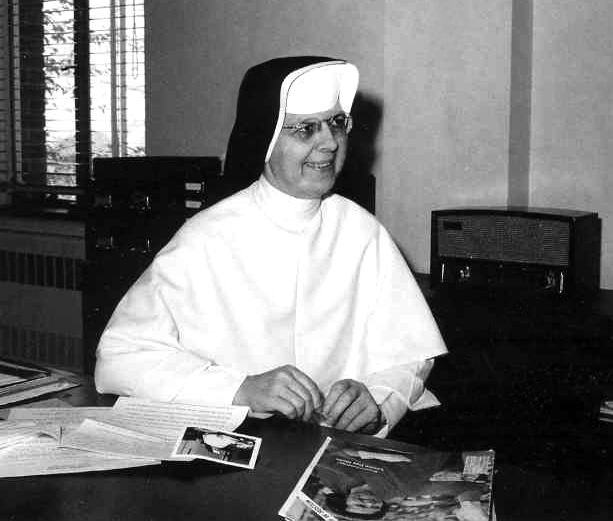
At Parke-Davis, Lucille Weber started work in the chemistry laboratory running the machine that put labels on the medicine bottles. Her job was to see that the machine was working properly. … After two years at Parke-Davis, though Lucille grew restless. There were parts of her life as a “career girl” that she liked, but she realized she did not want to stay in Detroit doing this kind of work for the rest of her life. She found she wanted more intellectual stimulation, and at this time her mind went back to her days at Saint Mary School and she began thinking more seriously of getting a college degree and someday teaching. She also thought more seriously about entering religious life. Later she recalled the blooming of her vocation as an outgrowth of the values she had been raised with.
“I would have to begin with my deep faith in God and in the example set by my parents who taught us materials things were not important. We learned to worship and had a reverence for the spiritual. I saw my parents go through the Depression and how their faith brought our family through.”
All of that led her to visit Grand Rapids and Marywood, the motherhouse of the Dominican Sisters of Grand Rapids whom she had known in her grade and high school days. As her goal of becoming a teaching and of living out her religious vocation melded into one, she felt her life plan come together. She went back to Parke-Davis for six months as she thought about her vocation and confirmed her decision. Then, in February, 1944, she briefly returned to the family farm to inform her family.
For the first few days, Lucille couldn’t bring herself to tell her parents. then, on a winter Sunday, she announced her plan. She told her family she was not going back to work at Parke-Davis. “Then where are you going?” they asked. “Marywood,” she replied. “I don’t have to stay, but I have to go and see if that is what I really want to do.”
Goodbye and Hello
On what turned out to be the coldest and snowiest day in February, the bus from Traverse City to Grand Rapids made a special stop on M-37 across from the Weber farm. There, Lucille’s father carried her suitcase on board and she followed. Then, after a brief good-bye, she was gone to her new life.
In those days, the first few years of formation for future sisters was difficult, especially for women like Lucille who had some experience of independence in the world. Her postulancy began immediately and would continue for six months. The break with an aspiring sister’s family was fairly complete as she learned whether or not she wanted to live with her new religious family and they with her. Postulants were not allowed to visit their families at home for three years, and could have visitors only once during the novitiate. …
Transition from “Working Girl” to “Vowed Sister”
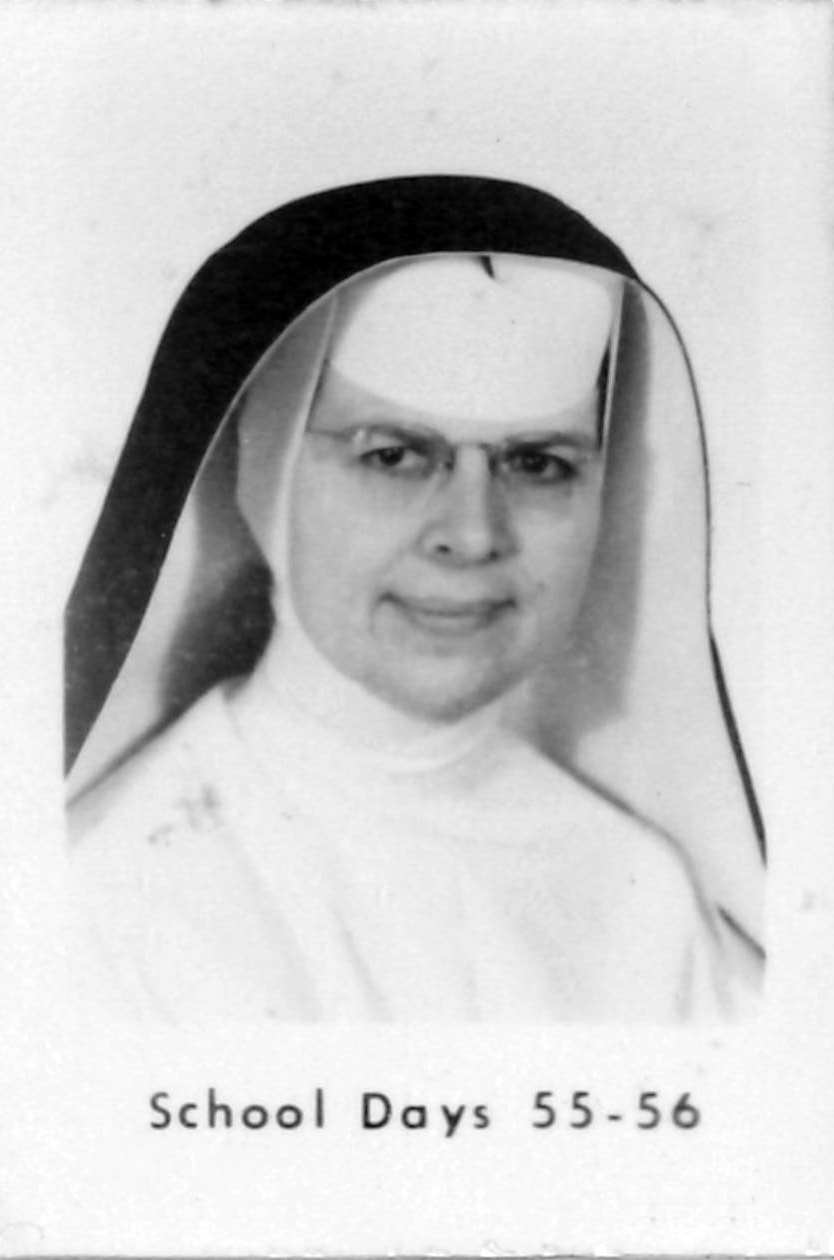
In 1947, Sister Sister Mary Aquinas Weber, was sent to her first teaching assignment at St. Stephen’s in East Grand Rapids.
Pictured is teacher, Sister Mary Aquinas Weber, during the 1955-1956 school year at St. Boniface School, Bay City, Michigan.
Used to living on her own as a “working girl” during the war, Lucille found the restricted life of the aspiring sisters a cause of some doubt about her vocation. The scheduled daily life, communal living, and the need to ask permission were especially difficult — as was the restriction on seeing movies. “In my single life in Detroit, I went to the movies once a week. At Marywood, one movie a year was brought in, in the summer, and the title had to be approved by the superior. There were only certain radio programs the sisters could listen to.”
Lucille had to ask herself whether she was ready to let those things go, and she admits, found it difficult at first. Soon, however, she found there were abundant compensations: new friends, going to classes at Aquinas College’s downtown campus, as well as learning about and participating in the community’s prayer and spiritual life and its special mission to social justice. Here she discovered that the prayer and liturgical life of the congregation were what bolstered everything the Sisters did. The community prayer life was the underpinning that had held the congregation together since the days of Mother Aquinata and, indeed, since the time of Dominican in the 13th century.
After completing her postulancy and novitiate training, Lucille Weber became Sister Mary Aquinas Weber in 1945.
Finally a professed member of the Dominican Sisters of Grand Rapids of the Congregation of the Sacred Heart, Sister Mary Aquinas completed her bachelor’s degree at Aquinas College and in 1947 was ready for her first assignment as a full-fledged teacher. Throughout the summer, the young sister wondered what that first assignment would be. She was ready and eager to go where she was needed.
Note: At the time Lucille entered, the [Dominican Sisters of Grand Rapids] congregation consisted of over 500 Sisters under Prioress Mother Euphrasia Sullivan. As the war came to and end, the teaching mission of the congregation was about to undergo an expansion. According to Sister Mona Schwind’s Period Pieces, between 1942 and 1948, 85 new Sisters would enter, and 606 professed Sisters would belong to the congregation by the early 1950s when many new schools were added to the Sisters’ mission to accommodate the post-war baby boom. When Sister Aquinas was elected to lead the congregation in 1966, more than 800 vowed members were serving the mission of the congregation.
Source: “Going Where We Are Needed, A Life of Sister Aquinas Weber, OP” by Gary Eberle. Published by Aquinas College, 2013.
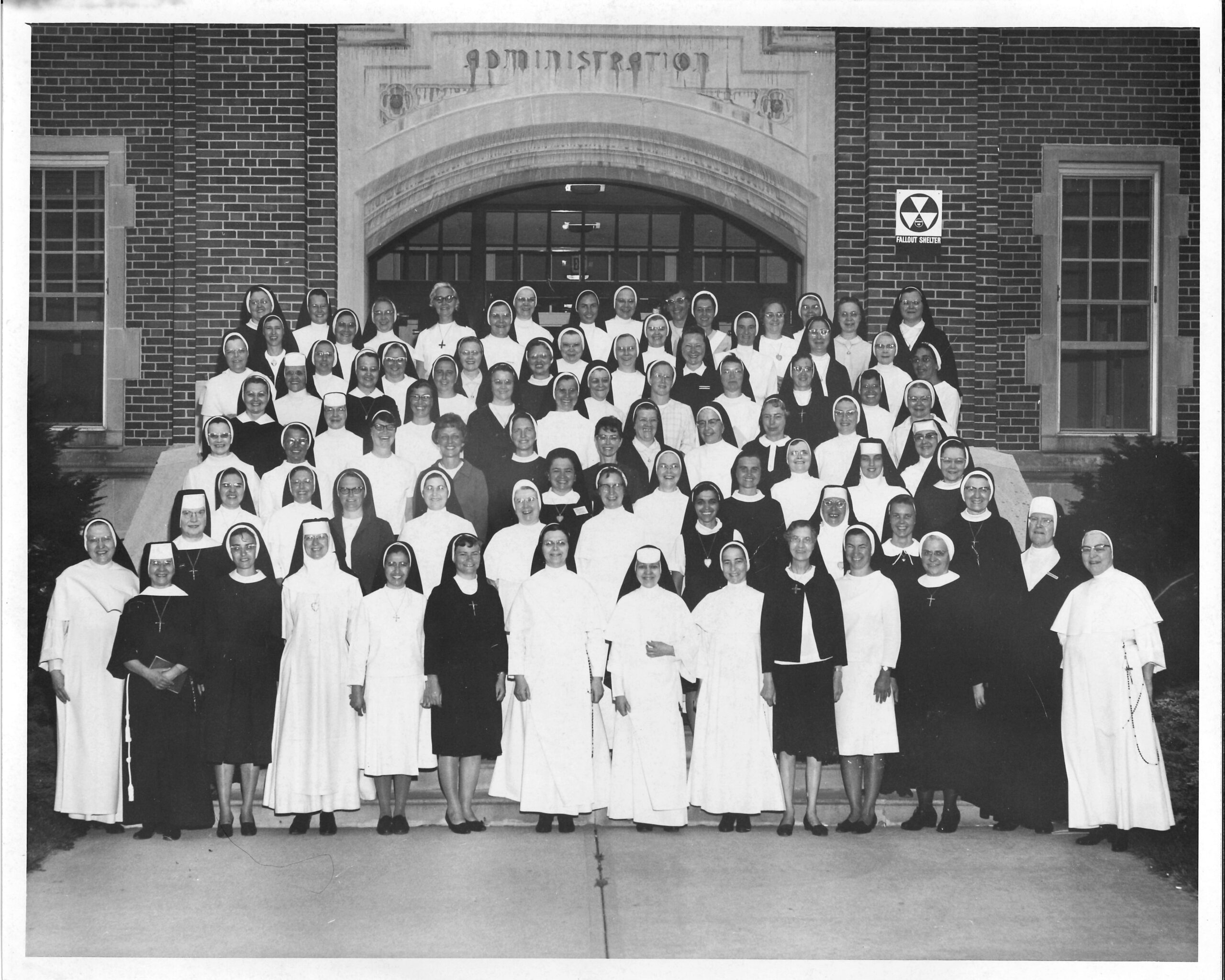
In 1966, at age 43, Sister Mary Aquinas Weber would be elected prioress of the Congregation she entered. Here, in 1968, she is pictured with Sisters at Aquinas College in Grand Rapids, Michigan.
80th Jubilee Message
At the time of her 80th year as a Sister, she wrote this Jubilee Message.
Psalm 92 — It is good to give thanks to the Lord, to sing God’s name,
to proclaim your steadfastness in the morning and your faithfulness in the night.
I came to Marywood on February 2, eighty years ago, coming from a farm located in Kingsley Michigan. After working two years at a Pharmaceutical company in Detroit, I made a decision to enter religious life with the Dominican Sisters who had taught me from grade to high school in St. Mary, Hannah. In my mind, if I did not like what I experienced after serious consideration I could leave.
Here I am eighty years later, having enjoyed each day with the opportunity to have time for community prayer, contemplation, and liturgy. While that strengthened my life, I was also blessed to have a rich opportunity for education, which enabled me to help people become more productive in their lives, especially those lacking basic needs, such as housing, food, medicine and clothing.
I thank the many wonderful sisters who have been on this journey with me. The opportunity for study, travel and leadership positions in and out of the congregation that have helped me to be able to share in the lives of our sisters and so many others who have been part of my public life.
My prayer for all those I know and love is embodied in Paul’s letter to the Colossians 1:9-12 (edited)
“I ask that you may be filled with knowledge of God’s will in all spiritual wisdom and understanding. May you be made strong with all the strength that comes from God’s glorious power and may you be prepared to endure everything with patience, while joyfully giving thanks.”
From entry day one, eighty years ago, the thought of leaving has never entered my mind!